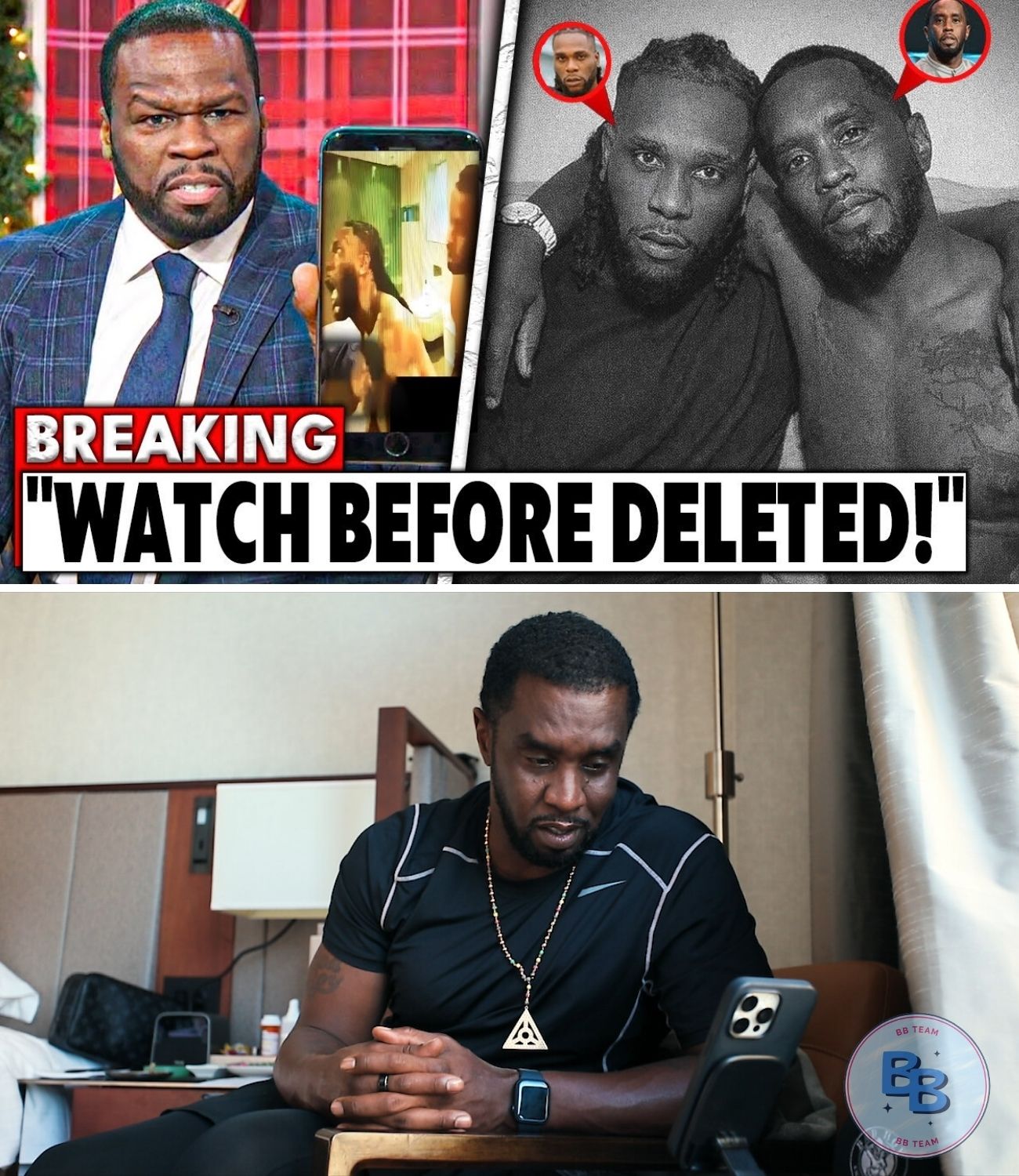
The unraveling of Sean “Diddy” Combs’ empire has moved beyond headlines into the realm of horror, with new allegations painting a picture of systemic manipulation, chemical control, and international exploitation. While 50 Cent continues his relentless campaign to “expose the truth” through his upcoming documentary, it is the voices of those who were in the room—former bodyguard Gene Deal and industry whistleblower Jaguar Wright—that are providing the most chilling details yet. From the disturbing theory behind the infamous “1,000 bottles of baby oil” to the alleged entrapment of global superstars like Burna Boy, the narrative has shifted from financial corruption to predatory dominance.
:max_bytes(150000):strip_icc()/Sean-Combs-documentary-120325-f86974c237a4495abff5de1362358e64.jpg)
One of the most viral and baffling details of the federal raids on Diddy’s homes was the seizure of over 1,000 bottles of baby oil. For months, the public treated this as a bizarre, perhaps fetishistic, quirk. However, Gene Deal, Diddy’s former head of security, offers a far darker explanation. In a recent interview, Deal challenged the official narrative, asking a pointed question: When police raid a brothel, do they seize the massage oil? No—unless it is evidence of a crime.
Deal alleges that the bottles were likely not just oil, but a delivery system for GHB (Gamma-Hydroxybutyrate), a central nervous system depressant known for inducing euphoria and, crucially, memory loss. “They knew what was in there,” Deal speculated, suggesting the oil was laced to facilitate the alleged assaults known as “Freakoffs.”
This theory is corroborated by Jaguar Wright, who broke down the “Freakoff Cocktail” in graphic detail. She described a mixture involving “Pink Cocaine” (often a mix of ketamine and ecstasy) and “Special K” (horse tranquilizer). According to Wright, this combination creates a “zombie-like” state where victims are physically pliable but mentally absent—unable to consent or recall the trauma until much later. “You wouldn’t feel a thing,” Wright noted, describing a calculated method of sedation used to prey on guests, including, she alleges, high-profile male celebrities.
The Burna Boy Connection: Fractured Trust
While the drug allegations are terrifying, the scope of Diddy’s influence reportedly extended across oceans. The video report shines a spotlight on Nigerian superstar Burna Boy, whose Grammy-winning album Twice as Tall was executive produced by Diddy. At the time, it was hailed as a bridge between Afrobeat and the global stage. Now, it is being viewed through a lens of suspicion.
The report suggests that Burna Boy’s relationship with Diddy may have soured due to “control masquerading as guidance.” 50 Cent’s documentary allegedly explores how Diddy used his power to lock artists into restrictive contracts that stripped them of creative freedom. There is speculation that Burna Boy’s recent silence regarding Diddy is not out of loyalty, but fear—or perhaps the result of an ironclad NDA. The narrative paints Burna Boy not as a collaborator, but as another potential victim of a system designed to harvest talent while compromising the artist.
The “Shopping Trip” and Normalized Abuse
Gene Deal also recounted a disturbing anecdote that highlights how normalized Diddy’s behavior was to his inner circle. Deal described a shopping trip to an adult store in Atlanta where Diddy allegedly purchased a bag full of “butt plugs” in broad daylight, handing the cashier a stack of cash without shame.
While the story might sound farcical, Deal uses it to illustrate a point: Diddy felt untouchable. This arrogance extended to his travel, where Deal describes uncomfortable private jet rides involving Diddy, other male rappers, and women, where the lines of professional boundaries were completely erased.
250 Cameras: The Ultimate Leverage
Why hasn’t the industry collapsed yet? Why are so many A-list celebrities, pastors, and politicians silent? The answer, according to Deal and Wright, lies in the tapes. Diddy’s homes were reportedly rigged with up to 250 cameras, capturing every illicit act, every drug-fueled “Freakoff,” and every compromised celebrity.
“He didn’t get that powerful without having ‘ups’ on somebody,” Deal stated. The implication is that Diddy has a “nuclear option”—a vault of footage that could ruin careers, marriages, and reputations instantly. This, insiders claim, is why figures like T.D. Jakes and various hip-hop moguls remain quiet. They aren’t just protecting Diddy; they are protecting themselves from being exposed on a “Freakoff” tape.
50 Cent’s Endgame
:max_bytes(150000):strip_icc():focal(749x0:751x2)/diddy-cassie-1-111623-7be4c54e06e1422398e4e2eba3e4e005.jpg)
Through it all, 50 Cent remains the loudest voice in the room. He claims to have personally funded legal teams for victims and secured “backups” of damning evidence, ensuring that even if Diddy’s team manages a legal maneuver, the truth will still come out. “I planned this two years in advance,” 50 Cent boasts.
As the investigation deepens, the picture becomes clearer: This wasn’t just about parties. It was, as Wright and Deal describe, a sophisticated operation of drugging, surveillance, and control that ensnared everyone from aspiring models to global icons. And if 50 Cent has his way, the whole house of cards is about to come crashing down.
About the Author